90-Day Limited Powertrain Warranty Included!

Blog

How Often To Change Oil For Optimal Vehicle Performance

How Often To Change Oil For Optimal Vehicle Performance

Taking care of your vehicle is key to maintaining its longevity and performance. One of the simplest yet most important tasks is changing the oil. But how often should you change the oil for optimal vehicle performance? In this blog post, we'll dive into why oil changes are so important, how frequently they should be done, and the factors that influence this decision.

Why Changing Oil Matters

Oil serves as the lifeblood of your engine. It oils the engine’s components, minimizes friction, and helps regulate temperature. Over time, oil breaks down and becomes less efficient. Regular oil changes keep everything running smoothly, allowing your engine to perform at its best.

How Often to Change Oil: The Basics

Most vehicles need an oil replacement every 3,000 to 7,500 miles. However, this range depends on the type of oil used and the conditions in which you drive. Conventional oils generally require more frequent changes, around every 3,000 miles. On the other hand, synthetic oils last longer and can often go up to 7,500 miles before needing a change.

For newer vehicles using high-quality synthetic oils, some manufacturers may even suggest intervals up to 10,000 miles. Consistently consult your owner's manual for the manufacturer's recommendations. Ignoring the suggested oil change schedule can lead to engine damage.

Factors That Affect How Often to Change Oil

While the general guidelines above can serve as a rule of thumb, a few factors can impact how often you need to change your oil:

  • Driving Habits: Short drives, stop-and-go traffic, and extreme weather conditions (hot or cold) can cause the oil to degrade faster. If you often drive in these conditions, you may need to change your oil more frequently.
  • Engine Type: Some modern engines are designed to run more efficiently, using oil that lasts longer. Vehicles with high-performance engines may require more frequent oil changes.
  • Oil Type: As mentioned, synthetic oils have a longer lifespan than conventional oils. Synthetic blends and full synthetic oils can help extend the time between changes.

Signs It’s Time to Change Your Oil

You don’t always have to wait for the mileage interval to change your oil. If you notice any of these signs, it might be time for a change:

  • Check Engine Light: Some vehicles have an oil replacement reminder light on the dashboard. If it comes on, it’s time for an oil replacement.
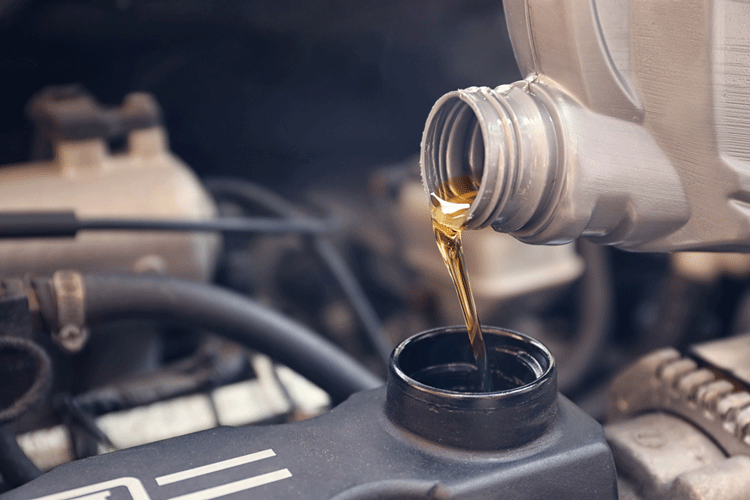
  • Dark, Dirty Oil: New oil is usually a golden-brown hue. If it’s turned dark and gritty, that means it’s no longer doing its job properly.
  • Unusual Engine Noise: If your engine starts to make more noise than usual, it could mean the oil is too old to keep everything running smoothly.
  • Excessive Exhaust Smoke: If your car is emitting excess smoke, it could be a result of low or dirty oil that’s failing to lubricate the engine.

Keep Your Engine Running Smoothly

Knowing how often to change oil is a simple but important part of vehicle maintenance. Frequent oil changes keep your engine running efficiently and can save you from costly repairs down the line. Sticking to a frequent oil change schedule is one of the easiest ways to protect your engine and keep it performing well.

If you're unsure when to change your oil next or need assistance, stop by Auto Kings for a quick and affordable oil change. Ready for your next oil change? Contact us for a professional oil change today and keep your engine running smoothly.
Recommended Posts

2014 Harley Ultra Limited

From High Desert Pines to Crashing Waves: Conquering the Oregon Coast on a 2014 Harley-Davidson Ultra Limited

Living in Central Oregon, we’re spoiled by towering ponderosa pines, jagged volcanic peaks, and endless bluebird skies. But every so often, the open road calls for something different: the crisp bite of salt spray, rolling Pacific fog, and the rhythmic thunder of surf breaking against rugged sea stacks. Few rides in North America rival the journey from the high desert over the Cascade Range and down to iconic U.S. Highway 101. We recently loaded up a vivid black 2014 Harley-Davidson Electra Glide Ultra Limited and pointed the front wheel west, tracking the Pacific coastline all the way to the windswept heights of Cape Perpetua. If you’ve ever wondered why grand American touring bikes exist, this ride answers the question within the first five miles. The Machine: 2014 Harley-Davidson Ultra Limited (Project RUSHMORE) Tackling a multi-hundred-mile cross-state haul through steep mountain passes, coastal dampness, and winding coastal two-lanes requires a motorcycle engineered for serious endurance. The 2014 model year marked the launch of Harley’s Project RUSHMORE —a major overhaul that refined grand touring comfort and road manners. Twin-Cooled High Output Twin Cam 103: Powering this 2014 Ultra Limited is the Twin-Cooled Twin Cam 103 V-Twin. With liquid-cooled cylinder heads tucked discreetly inside the lower fairings, it maintains peak power and rider comfort even in slow coastal traffic and climbing summer grades. Pumping out over 105 lb-ft of low-end torque, you can roll on the throttle in sixth gear and let that signature American rumble pull you up coastal headlands without endless downshifting. Splitstream Fairing Aerodynamics: The wind-tunnel-designed Batwing fairing features the center Splitstream vent, equalizing air pressure to virtually eliminate helmet buffeting across windy coastal headlands. Touring Comfort & Hidden Brembo Hardware: Between the plush seating, one-touch saddlebag latches, and spacious Tour-Pak trunk, long days in the saddle are effortless. When damp ocean pavement demands sudden stopping power, the factory Reflex Linked Brembo ABS brakes (stamped with the Bar & Shield script on the outside, but engineered by Brembo) distribute braking force evenly between wheels for rock-solid stability. Cape Perpetua: Centuries of Maritime and Coastal History Rising steep above the churning Pacific south of Yachats, the massive headland of Cape Perpetua carries deep layers of Pacific Northwest history dating back thousands of years. Ancient Indigenous Lands: For over 6,000 years before European arrival, the area was home to the Alsea people. Shell middens along the surrounding coves still tell the story of generations harvesting mussels, clams, and marine life along these rocky shelves. Named by Captain Cook (1778): On March 7, 1778, British explorer Captain James Cook sighted this prominent headland during his third voyage across the globe aboard the HMS Resolution. Because he spotted the bluff on St. Perpetua’s Day, he named it Cape Perpetua —one of the earliest documented English geographic place names in the entire state of Oregon. Great Depression Stonework (1930s): During the Great Depression, the Civilian Conservation Corps (CCC) established Camp Perpetua at the base of the mountain. CCC crews hand-built the winding trails, access roads, and the stone lookout shelter perched near the crest—constructed with the same rugged rustic masonry style seen at Central Oregon's own Dee Wright Observatory. World War II Coastal Radar Post: Following the attack on Pearl Harbor, the U.S. military recognized the strategic elevation of Cape Perpetua. Soldiers transformed the stone CCC shelter into a coastal aircraft-warning station and temporary radar installation, watching the horizon day and night to guard the Pacific coastline from enemy submarines and naval vessels. Geological Spectacles Below: Looking straight down from the heights, Highway 101 hugs the edge of the Cape Perpetua Marine Reserve, home to violent geological features forged by volcanic basalt—including Thor’s Well, Devil’s Churn, and the Spouting Horn, where high-tide ocean swells shoot spray into the air like natural geysers. The Transition: High Desert Heat to Marine Layer One of the greatest joys of riding or driving out of Bend and Redmond is experiencing Oregon's diverse biomes in a single day. You can start your morning under dry high-desert sunshine, carve through the cedar-scented switchbacks of the Cascade passes, roll across the lush Willamette Valley, and finish your day listening to the surf crash as the Pacific marine layer cools your engine. It’s the kind of route that resets your perspective and reminds you why we live in this corner of the country. Your Adventure Starts at Auto Kings Whether your idea of the ultimate road trip involves the open-air pulse of a heavyweight touring motorcycle, the precision handling of a supercharged sports coupe, or the go-anywhere confidence of a family-hauling 4x4, the Pacific Northwest was built to be explored. At Auto Kings, we don't just sell vehicles—we live for the drives they make possible. Stop by our Bend or Redmond locations today to check out our hand-picked inventory, swap road-trip stories, and find the machine ready for your next Pacific Northwest journey.

Camaro ZL1 Dee Wright Observatory

Taming the Lava Fields: Why McKenzie Pass (OR-242) Is Central Oregon’s Ultimate Driver’s Road

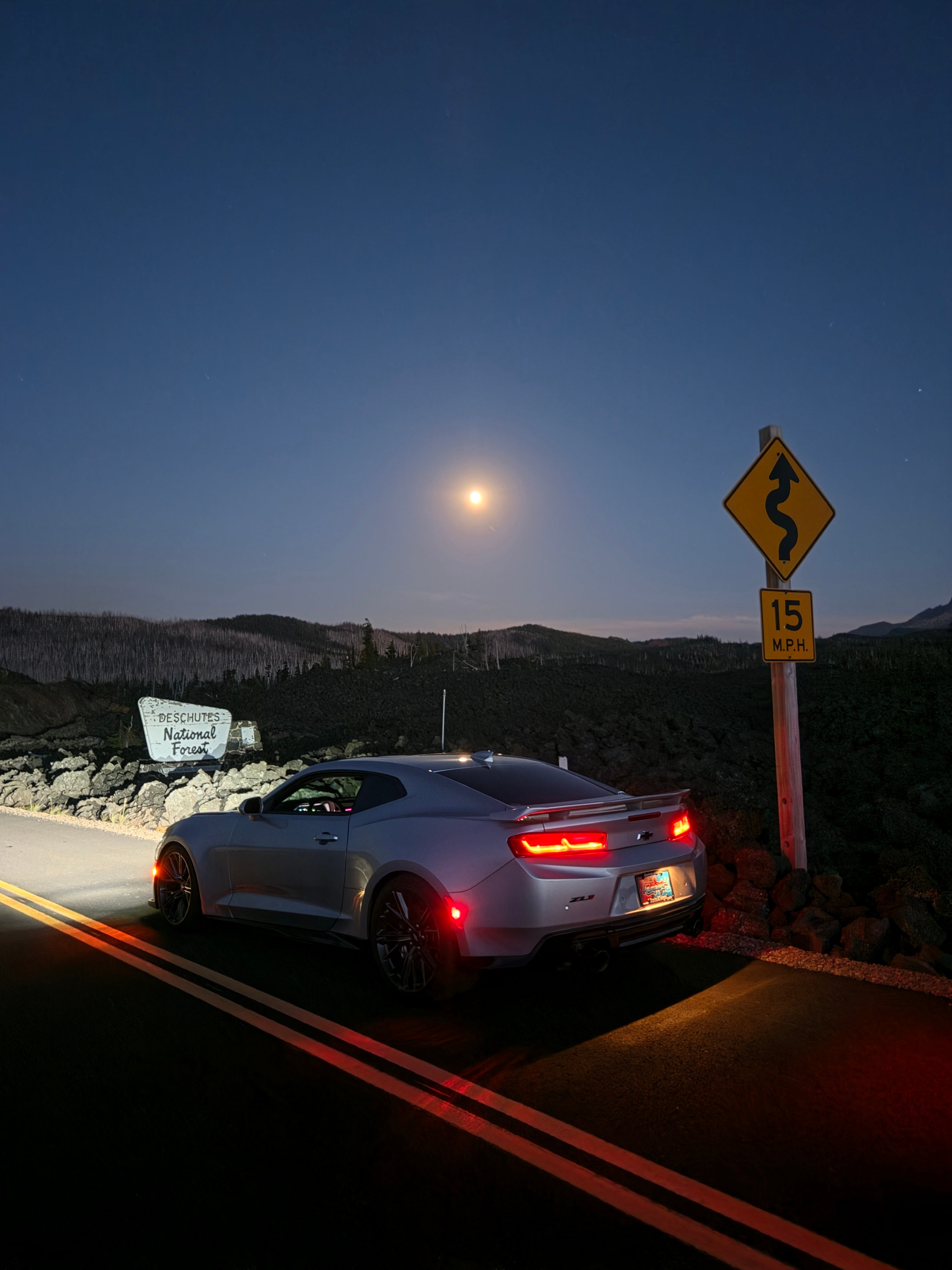
Taming the Lava Fields: Why McKenzie Pass (OR-242) Is Central Oregon’s Ultimate Driver’s Road Living in Central Oregon means some of the most dramatic driving terrain in the country sits right outside our doors. You do not need to cross five state lines to find world-class asphalt; McKenzie Pass Highway (OR-242) is right in our backyard. Beginning just west of Sisters, Highway 242 climbs out of fragrant ponderosa pine stands, snakes through relentless hairpin switchbacks, and breaks above the tree line into a 65-square-mile sea of jagged volcanic basalt. We took our silver 2017 Chevrolet Camaro ZL1 up to the summit at dusk to run the pass under the moonlight. The route proved why this stretch of pavement remains an essential bucket-list drive for true driving enthusiasts. The Pedigree of the 2017 Camaro ZL1: A Track Weapon on Mountain Asphalt When Chevrolet introduced the sixth-generation Camaro ZL1 in 2017, the model evolved beyond straight-line muscle into a legitimate world-class sports car. Developed on GM’s lightweight Alpha platform, the sixth-gen ZL1 was engineered specifically to set blistering lap times on the world's most demanding circuits, including a documented 7:16.04 lap at Germany’s notorious Nürburgring Nordschleife. Under the carbon-fiber heat extractor on the hood sits a supercharged 6.2L LT4 small-block V8, factory rated at 650 horsepower and 650 lb-ft of torque. Instant Forced Induction: The 1.7-liter Eaton supercharger delivers immediate low-end torque without turbo lag, pulling hard out of slow second-gear corners and climbing steep alpine grades effortlessly. Magnetic Ride Control: Magnetorheological dampers read the pavement every millisecond, adjusting shock stiffness instantly to keep the tires planted over uneven mountain frost heaves and camber changes. Precision Braking & Aero: Massive 6-piston front Brembo calipers gripping 15.35-inch two-piece rotors provide fade-free deceleration going into tight turns, while functional aero components—including the aggressive front splitter, "flowtie" grille emblem, and rear spoiler—maintain high-speed downforce and powertrain cooling. On a road like OR-242, the ZL1 feels balanced, planted, and precise rather than unwieldy. OR-242: A Short-Lived Season on an Unforgiving Mountain Unlike standard mountain highways, Highway 242 is untouched by modern winter maintenance. The road is unplowed, unsalted, and unpainted for long stretches, preserving its raw character. The Snow Window: Winter snowpacks reaching up to 14 feet shut the highway down behind snow gates from roughly November through late June or early July. This leaves only a narrow late-summer window for automotive enthusiasts to experience the route. Historic Evolution: Long before asphalt was laid, this corridor was an ancient trade route used by Indigenous peoples. In 1862, pioneer Felix Scott Jr. cleared a rough trail across the basalt to move supply wagons and cattle to the Idaho mines. By 1872, the route operated as a privately held wagon toll road before being incorporated into the state highway system in the 1920s. In 1962, when commercial traffic shifted permanently to modern Highway 126, OR-242 was preserved as a dedicated Scenic Byway. The Dee Wright Observatory: An Otherworldly High Desert Stronghold At the 5,325-foot summit sits the Dee Wright Observatory, a striking stone stronghold that looks like an ancient fortress rising from the lava rock. Built by the CCC (1935): Constructed during the Great Depression by the Civilian Conservation Corps (Company 1927), the structure was built entirely from surrounding native basalt. It was named in honor of Dee Wright, the project’s veteran Forest Service foreman who passed away in 1934 before construction finished. Framed Viewing Portals: Inside the shelter, builders cut precise viewing slits into the stone walls, each angled to frame a specific Cascade peak. The 1937 Bronze Compass: Ascending the exterior stairs leads to an open rooftop observation deck anchored by a bronze azimuth/peakfinder disk. Cast in 1937 by students at Portland’s Benson Polytechnic School, the brass instrument pinpoints the bearings and elevations of the surrounding horizon—including North and Middle Sister, Mount Washington, Belknap Crater, and Mount Jefferson. Moonscape History: The surrounding black volcanic field—formed by basalt flows from Little Belknap Crater and Yapoah Cone thousands of years ago—is so stark and barren that NASA used the site in 1964 to train Apollo astronauts for lunar surface missions. Find the Right Machine for the Open Road Highway 242 reminds drivers that the journey matters just as much as the destination. Central Oregon offers exceptional driving landscapes, but enjoying them to the fullest requires the right machine under your control. Whether you want a supercharged performance coupe to carve mountain apexes, a high-clearance 4x4 to explore remote forest roads, or an efficient daily driver, the Pacific Northwest was built to be explored. Visit Auto Kings in Central Oregon to view our hand-picked inventory and find the platform for your next mountain run.

Key West

From the High Desert to Mile Marker 0: Why the Minivan Is the Undisputed King of the Cross-Country Road Trip

When car enthusiasts envision the ultimate cross-country road trip machine, minds usually drift toward sleek convertibles, thunderous V8 grand tourers, or lifted overland rigs. But when you’re loading up the entire family to cross multiple state lines, tackle thousands of highway miles, and drive until the pavement literally runs out in the ocean, one vehicle class quietly takes the crown: the minivan. We were recently blessed to take on an iconic American pilgrimage—driving all the way down through the Florida Keys to stand beneath the legendary Mile Marker 0 sign in Key West. Our chariot for the long-haul journey? A Chrysler Pacifica. Standing at the official southern terminus of U.S. Route 1 after crossing dozens of bridges suspended over turquoise water, one thing became crystal clear: when it comes to keeping a family comfortable, organized, and sane across thousands of miles, nothing beats a purpose-built family hauler. Here is why the humble minivan remains the ultimate long-distance road-trip platform. 1. Dual Power Sliding Doors: A Road-Trip Superpower Ask any parent who has navigated a packed interstate rest stop or a tight parking stall in historic downtown Key West—traditional swinging doors simply cannot compete. Zero Parking Lot Stress: Power sliding doors eliminate door-ding anxiety completely. Your kids can hop in and out freely without clipping adjacent vehicles, no matter how tight the space. One-Touch Loading: When your hands are full of luggage, beach towels, and road trip snacks, a tap of the key fob or a wave of your foot opens wide entryways without wrestling handles. 2. Genuine Three-Row Comfort & Unmatched Cargo Packaging While large SUVs look rugged on the outside, their interior packaging often forces compromises. Minivans, on the other hand, are engineered around maximum interior volume and ease of use. Real Legroom in Every Row: Unlike the cramped third rows found in many midsize crossovers, minivans provide full-size seating where adults and teenagers can actually stretch out for hours. Deep Cargo Wells & Hidden Storage: Deep rear trunk wells and fold-flat floor systems (like Chrysler’s Stow 'n Go) mean coolers, suitcases, strollers, and souvenirs can be stowed low and out of sight, keeping your rear view clear and cabin uncluttered. 3. Effortless Highway Cruising & Fuel Efficiency Covering thousands of miles across state lines means highway efficiency directly impacts both your travel time and your fuel budget. Sleek Aerodynamics: Sitting lower to the ground than heavy body-on-frame SUVs, minivans glide through the air far more efficiently, returning impressive highway MPG. Fewer Fuel Interruptions: Efficient cruising translates to extended highway range, allowing you to bypass congested exits and keep momentum on open interstate stretches. 4. Built-in Road Trip Tech & Practical Comforts Keeping everyone calm, entertained, and recharged across thousands of miles is essential for a peaceful journey. Abundant Power & Connectivity: Dedicated USB and power ports in every row keep tablets, phones, and gaming devices charged around the clock. Thoughtful Cabin Design: From integrated sunshades to endless cupholders and smart storage cubbies, everything has a designated home—preventing the inevitable "road-trip chaos" from taking over your driving environment. The Destination Is Great, but the Journey Matters Most Standing beside the Mile Marker 0 sign in Key West—the start of a highway that runs 2,369 miles all the way to Fort Kent, Maine—serves as a great reminder of why we drive. A successful family road trip isn't about bragging rights or horsepower; it’s about the memories made looking out the windows, the easy laughter across the rows, and arriving safely with smiles on everyone’s faces. Whether you're gearing up for a cross-country family expedition, looking for a dependable daily commuter, or hunting for a weekend adventure rig, visit us at Auto Kings in Central Oregon. We’re here to help you find the right vehicle to get your family out making memories on the open road.